Showing posts with label Clark Gable. Show all posts

Tuesday, July 20, 2010

Gone with the Wind

"No, I don't think I will kiss you, although you need kissing, badly. That's what's wrong with you. You should be kissed and often, and by someone who knows how." --Rhett Butler to Scarlett O'Hara (Gone with the Wind)
I'm sitting in the dark as I write this, trying to ignore the heat that is winding its way through the windows and into my pours with such efficiency.  The fan that I've positioned about a foot from my face just seems to be blowing more hot air, no matter that I've positioned a bowl of ice next to it as a kind of makeshift air conditioner.  And even though I've put my sheets in the freezer, I still feel like I'm stranded in the desert, rather than in New England.  I suppose it was smart of me then, to time this film with the first real heat wave of the summer.  Watching Atlanta burn does seem to be making me feel a little better.  And with that introduction, I give you...Gone with the Wind...

Scarlett at Tara
The Plot
Irish born plantation owner Gerald O'Hara, played by Thomas Mitchell, lives in Georgia with his wife Ellen and his three daughters, Suellen, Katie Scarlett, and Carreen.  Scarlett, played by Vivien Leigh, is the most beautiful and popular of all the young women in the county, though she is vain, spoiled, and in love with the one man she can't have, Ashley Wilkes, the only son of a neighboring plantation owner. Ashley, played by Leslie Howard, is about to marry his cousin, Melanie Hamilton, played by Olivia de Havilland.  When Scarlett confesses her love, Ashley, though intoxicated by her beauty and spirit, chooses the sweet, even-tempered Melanie, knowing that they are much more compatible.  Rhett Butler, a rogue with questionable morals played by Clark Gable, witnesses Scarlett's tantrum and is immediately fascinated by her.  But soon after, the Civil War breaks out and Scarlett marries Melanie's brother, Charles, out of spite just before all the men go off to war.  Charles dies shortly after of measles, and Scarlett is widowed.

Scarlett at the Wilkes' picnic
Bored and upset because she has to dress in black, Scarlett decides to visit Melanie and her Aunt Pittypat in Atlanta.  Mammy, Scarlett's slave nursemaid played by Hattie McDaniel, warns her to stay away from Ashley.  In Atlanta, Scarlett shocks everyone by agreeing to dance with Rhett Butler, even though she is in mourning.  Rhett visits her and buys her presents, but once Ashley returns, she has eyes only for him.  Though Ashley can't turn her away he does make her promise to look after the now pregnant Melanie while he's gone.  Soon, however, Scarlett's life turns from a high society social whirl to endless days of assisting Melanie to care for the wounded soldiers pouring in.  

Scarlett dances with Rhett, though she's a widow.
As the Yankees come closer to Atlanta, instead of fleeing with the rest of the city Scarlett must stay as Melanie prepares to give birth.  Alone, Scarlett helps Melanie through a difficult birth before loading her, their slave, and Melanie's young son into a wagon, and fleeing the now burning city.  She turns to the only man left, Rhett Butler, to get them safely out to her home, Tara.  Rhett gets them close, and then leaves to join the war, though the South is losing.  He confesses his love for Scarlett, and then kisses her despite her protests.  Scarlett must fight through Yankees and mud before finally arriving home.
Scarlett hides from the Yankees.
Tara has changed completely since Scarlett's last visit.  Her mother has just died of typhoid fever, and both her sisters are still ill. The Yankees have stolen everything worth taking, and all the slaves except for Mammy and a few older slaves have gone.  Her father has been driven mad with grief, and there is nothing for anyone to eat.  Scarlett climbs to the top of a hill and manages to find a radish left in the dirt.  She shovels it down, then collapses in despair.   Dirty, tired, and hungry, Scarlett vows that "as God is my witness, they're not going to lick me. I'm going to live through this and when it's all over, I'll never be hungry again. No, nor any of my folk. If I have to lie, steal, cheat or kill. As God is my witness, I'll never be hungry again."  
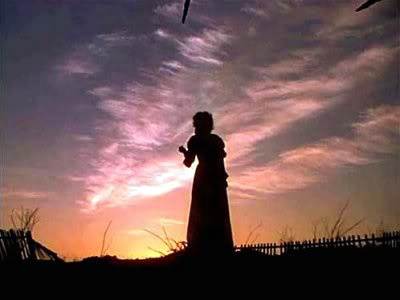
"As God is my witness, I'll never be hungry again."
Under Scarlett's orders, everyone works together to pick cotton to sustain them, much to her sisters' chagrin.  A Yankee tries to steal her mother's earrings, forcing Scarlett to shoot him and a bedridden Melanie to help her bury the body.  Scarlett's father has lost his sanity, rides his horse dangerously, and falls and breaks his neck.  Ashley returns home alive and is reunited with his family, though his home is destroyed and he must stay at Tara with Scarlett posing a constant distraction.  They have many mouths to feed, including the homeless Confederate soldiers they've begun taking in. Taxes are piling up on Tara and Scarlett must find a way to save her home.  She dresses in velvet green curtains, the only fabric left at Tara, and travels with Mammy back to Atlanta in search of Rhett, the only man she's known to consistently have money.

Ashley and Melanie
Rhett is in genteel captivity, gambling with his captors and smuggling in luxury goods.  Scarlett pretends to be the debutante she was, and Rhett pretends he has the money to help her, before both reveal themselves as frauds.  Leaving the jail, Scarlett runs into Frank Kennedy, an older man and former soldier who hopes to marry her sister Suellen once his new convenience store makes enough money.  Sensing he could save Tara, Scarlett steals him away from her sister and marries him herself.  Scarlett convinces her new husband to pursue the lumber business, and Ashley to reluctantly join them.  Under her ruthlessness, the lumber business thrives and Scarlett becomes wealthy again.  But Scarlett's arrogance takes a turn when she is attacked while driving through a shanty town.  Her husband and Ashley go to subdue the poor white people who attacked her without Scarlett's knowledge.  But Frank ends up dead and Ashley injured, though he stays out of jail through Rhett's quick thinking.

Rhett convinces Scarlett to marry him.
Filled with the new emotion of guilt, Scarlett gets drunk after the funeral.  Rhett comes to visit and proposes marriage, and Scarlett accepts though she tells him she still loves Ashley.  Rhett spoils Scarlett, giving her everything she ever wants, even restoring Tara to its former glory.  But he cannot break her obsession with Ashley, and after their daughter Bonnie is born, Scarlett refuses him her bed so they she won't have any more children and lose her figure.  Hurt, Rhett lavishes all his love and attention on Bonnie, and when Scarlett is caught in a compromising position with Ashley, he decides to take Bonnie away to Europe.  It falls to Melanie to instantly forgive Scarlett and save her social standing.  The night before he leaves, Rhett gets drunk and ravishes Scarlett, carrying her up the stairs.

Rhett and Scarlett
Though Rhett spoils Bonnie, she still misses her mother.  So he takes her home and immediately quarrels with Scarlett, who has missed them both but won't admit it.  Scarlett does  admit that she is pregnant, but the violence of her fight with Rhett causes her to fall down the staircase and lose the baby.  Scarlett calls out to Rhett in her delirium, but he never knows, lost in his own guilt.  Later, the two parents watch Bonnie ride her new pony.  Scarlett, noticing the same heedlessness her father often displayed on a horse, asks Rhett to get her down.  Suddenly Bonnie falls from the horse and breaks her neck.

Bonnie on her horse.
Rhett is beside himself with grief, and Melanie comes to comfort him.  She is pregnant as well, despite the doctor's orders that another pregnancy might kill her.  While comforting Rhett and Scarlett, whom she has always stuck up for and treated as a sister, Melanie miscarries.  Melanie lays dying in her home, and calls for Scarlett first.  She tells her to look after her husband and son, as well as Rhett, who "loves her so."  Scarlett comes out and cries in Ashley's arms, which is too much for Rhett, who leaves.  Noticing the depth of Ashley's despair, Scarlett realizes that Ashley truly loved Melanie, and was simply too weak to turn Scarlett down.  She realizes she loves Rhett and races back to tell him so.  But Rhett can no longer believe it, and packs his bags to leave, despite Scarlett's declarations of love.  When she asks what should she do if he leaves her, he utters the famous line, "Frankly, my dear, I don't give a damn."  As Rhett walks off into the mist, Scarlett collapses on the stairs.  Finally she looks up as a montage of different people speaking of Tara runs though her head and says the final lines of the film, "Tara! Home. I'll go home. And I'll think of some way to get him back. After all...tomorrow is another day."

Rhett leaves Scarlett.
The History
Producer David O. Selznick bought the rights to Margaret Mitchell's hit novel of the same name only a month after it was published in 1936 for $50,000.  Though the film would officially be produced by Selznick's own company, Selznick International Pictures, every major studio wanted to join forces until Selznick finally agreed to the terms set by his father-in-law, Louis B. Mayer.  Mayer gave Selznick $1.25 million towards production costs along with the use of Clark Gable and in turn received exclusive distribution rights and 50% of the profits.  

Burning of the Atlanta Depot
It was three years before this film was finally released, and it would be subjected to a large variety of problems along the way, most of which occurred because of Selznick's determination to be in charge of every aspect.  The script was never fully completed, and every writer that attempted a re-write had to contend with Selznick leaning over his shoulder making changes.  While Gable eventually took the part of Rhett, it was with great reluctance and much negotiation.  He agreed after being promised a $50,000 bonus which would enable him to divorce his current wife and marry Carole Lombard.  The "Search for Scarlett O'Hara" turned into a six month publicity stunt where nearly 1,400 actresses were interviewed before they finally settled on a relatively unknown British actress named Vivien Leigh.  Leslie Howard insisted on wearing extra makeup and hairpieces, as he felt that he was far too old to play the part of Ashley Wilkes, who is 21 at the beginning of the film.  The film also went through three directors: George Cukor, Victor Fleming, and Sam Wood.  Selznick's overbearing attitude led to the dismissal of George Cukor after only three weeks of shooting, though he had spent nearly 2 years in pre-production with Selznick.  Cukor was replaced by Victor Fleming, whose macho attitude irritated many of the women on the set.  Both Leigh and de Havilland would continue to receive private instruction from Cukor at their own request.  But Selznick's micro-managing made Fleming have a nervous breakdown, causing another MGM director, Sam Wood, to fill in and finally assist Fleming with wrapping up the film. In addition Selznick also changed the cinematographer after a month because he felt the film was "too dark."  And none of this includes the stack of daily memos he sent regarding costume, scenery, music, and lighting.  The film cost $3.9 million to make, which included the $25,000 it cost to film the burning of the Atlanta Depot.  The first scene to be shot, the raging fire was created by burning old MGM lots that needed to be taken down anyway.  They used every one of the seven cameras in existence for technicolor at that time.  The blaze was so intense that residents of Los Angeles jammed the phone lines, thinking that MGM was burning down.  With all the problems, the movie industry began referring to the picture as "Selznick's Folly."

Vivien Leigh as Scarlett O'Hara
But Gone with the Wind made good on its hype.  With adjustments made for inflation, Gone with the Wind is the still the highest grossing movie in North America according to Box Office Mojo.  It won 10 Academy Awards (2 of them honorary) a record that would stand for twenty years.  According to AFI's 1998 list of the 100 best American films, Gone with the Wind is #4 (though it dropped to #6 in 2007).  Rhett's final line is also listed as AFI's #1 best movie quote of all time.  In order to preserve the line, the Motion Picture Association had to pass an amendment to the Production Code that forbade use of the words "hell" or "damn" a month before the film was released.  They decided with much reluctance that those words would be allowed if their use "shall be essential and required for portrayal, in proper historical context, of any scene or dialogue based upon historical fact or folklore…or a quotation from a literary work, provided that no such use shall be permitted which is intrinsically objectionable or offends good taste." When it was released it was also the longest sound film ever made with a unprecedented 3 hours and 40 minutes in length (and a 15 minute intermission).  The final script had been cut down from the original, which had been over 5 hours long.

Scarlett and Mammy
Although the racial stereotyping of the film is often called into question, particularly the portrayal of a "mammy" character, Hattie McDaniel would be the first African-American to win an Academy Award (Supporting Actress).  McDaniel was not allowed to attend the premiere in Atlanta because of segregation laws, however, and had to convince Gable to go anyway, though he wanted to decline in protest.   Butterfly McQueen's performance in particular as Prissy,a young slave girl, caused Malcom X to feel "like crawling under the rug."  McQueen herself disliked the racial implications of the role though she said "Prissy should have been slapped often, because she was horrid!" And though modern audiences might wince at the stereotypes, Selznick worked hard to portray African-Americans in a positive light: "I have gone to extremes in the preparation and the casting of the picture, to avoid any derogatory representation of the Negroes as a race or as individuals and to eliminate the major things in the story which were apparently found offense by Negroes in the Margaret Mitchell book.  I feel so keenly about what has happened to the Jews in the world that I cannot help but sympathize with the Negroes in their fears about material which they regard as insulting and damaging."  Selznick therefore removed all mention of the Klu Klux Klan and the word "nigger" from the film's script, a small victory in 1939.

Hattie McDaniel wins an Oscar.
Any other year the awards might have gone to other great films like The Wizard of Oz, Mr. Smith Goes to Washington, Wuthering Heights or Goodbye, Mr. Chips.  But this year Gone with the Wind beat them all with hardly any effort.  This awards ceremony would be the first to be filmed and shown later as a short film (directed by Frank Capra), causing many actresses to begin stressing over their wardrobes and jewels.  Though the Academy made the press promise not to reveal the winners, The Los Angeles Times still spilled the beans to several late comers, including Clark Gable and Bette Davis.  The highlight of the night was clearly when Hattie McDaniel won her Oscar.  Covered in gardenias, McDaniel received the loudest applause of the night and could barely make it through her studio prepared speech before running back to her seat, sobbing.  Olivia de Havilland, disappointed by her loss in the same category ran into the kitchen and began crying as well.  Irene Mayer Selznick followed her and told her to grow up, that she'd have plenty of other chances for an Oscar and to go congratulate her costar for what would surely be the biggest point of her career.  Olivia de Havilland did just that, and remembered it as a significant "learning experience" of her life.  Actress Fay Bainter said, when presenting the award, "This is more than an occasion.  It is a tribute to an country where people are free to honor noteworthy achievements regardless of creed, race or color."

Clark Gable reads Gone with the Wind.
Gone with the Wind has inspired documentaries, themed weddings, novelty stores, parodies and even sequels.  Today it is remembered as one of the best movies ever made and the film that defined the "epic" genre.

The Verdict?
How is it possible to review a film like Gone with the Wind?  Even writing this post was an epic task.  This film is so much more that I can't really get a grasp on how I feel about it.  For me, it's not a film to be watched often.  For one thing, it's extremely long.  And it feels long.  For another, this film doesn't have what I'd call a happy ending.  Every time I watch it I become invested in the characters until I hit the last 45 minutes and everything falls apart.  I warn myself that this is going to happen, and that I shouldn't get too involved.  But I always let myself forget until...miscarriage, death, divorce...somehow all of this is more gut-wrenching than watching all the Confederate soldiers in Atlanta die from flesh wounds.  Then again I am a Yankee.

Scarlet falls down the stairs.
I want to say I dislike this movie.  But I feel that like and dislike are words too tepid for this film.  And it is extraordinary.  Every scene is filled with rich color, lavish sets, and incredible actors.  Selznick does nothing on a small scale.  Just as far as sheer production value, this must surely be the best movie ever made.  Even the music is perfect, a sweeping score that helps to draw the viewer in even deeper.  And all of the actors are incredible as well, particularly Vivien Leigh, who manages to make the audience like Scarlett and root for her even as she shows a complete disregard for the feelings of others.  Of course my favorite character is Mammy, who is the only person in this movie who knows what the hell is going on and has the temerity to comment on it.  When she likens her beloved Scarlett to a spider lying in wait for Ashley (to her face)...well...that might be my second favorite line.

Scarlett visits Rhett dressed in drapes.

Despite all of that, this movie doesn't rank as one of my top favorites, only because of the fact that I end the movie screaming and throwing things at Scarlett.  It's uncomfortable.  And I hate cliff hangers.  But like Rhett to Scarlett, I can't help being drawn to this film, even if I know that it's bad for me.  I'm sure five years from now I'll get tricked into watching it again, and I'll go through the same emotional reaction.  But there's something about this movie that keeps me coming back to it.  Something grand and wonderful.  And then there's my favorite line of the movie, the one that I've put above.  Just for Clark Gable delivering that line will I watch this movie over and over again. I'll just skip through the scenes with Prissy.  Her voice is like nails on a chalkboard.


My final verdict?  Watch it.  One day when you're bored and you have nothing else going on.  Sit for four hours and watch one of best movies of all time.  And while every moment is worth it, don't expect you'll be going back to Tara anytime soon.
Enhanced by Zemanta

Monday, May 3, 2010

Mutiny on the Bounty

 "When you're back in England with the fleet again, you'll hear the hue and cry against me. From now on they'll spell mutiny with my name." -Fletcher Christian to Byam, Mutiny on the Bounty
Okay, at the risk of completely destroying my credibility as a serious blogger and alienating my male readers (if any)--Clark Gable as a shirtless buccaneer = yum.  That's it, I swear, at least until Gone With the Wind.  I should get credit for holding back in my last movie post.  What was I writing about again...right!  Adventure, intrigue, foreign lands, high seas, dastardly villains, tragic heroes, romance and of course...ahem...Clark Gable...

The Plot
Fletcher Christian, played by Clark Gable, is first mate on a ship called The Bounty, headed to Tahiti for a two year journey to bring back breadfruit trees.  He rounds up sailors by both jails and impressment, forcing in particular a young man who does not wish to leave his wife and son.  Ensign Byam, played by Franchot Tone, coming from a long line of wealthy and power naval officers, naively heads to the ship as well in his first naval posting as midshipman.  He has been given his post by a Sir Joseph Banks, a wealthy family friend with great connections who has charged Byam with writing a Tahitian dictionary.  Captain Bligh, played by Charles Laughton, prepares to launch the ship by first flogging a man who has given offense.  Just before the flogging begins, the man is pronounced dead.  This does not deter Bligh who insists the flogging be carried out anyway.
Fletcher Christian and Captain Bligh
This incident sets the tone for a long voyage of cruelty and suffering for the crew.  Not even the officers are exempt, and Bligh takes particular delight in the fact that because they sail in wartime (though they are not actually fighting) he has the power to reprimand anyone for any offense.  He skimps on food and pockets the funds, demands insane amounts of work, and comes up with terrible punishments for the least offense.  Christian, clearly a man of good principle and experience, is forced to stand by and hold on to his temper as Bligh makes everyone miserable.  Bligh is pronounced one of the best sailors Christian has ever worked for, but the worst captain.
Fletcher Christian refuses to sign the log
When Bligh asks Christian to sign the ship's log documenting falsified rations, Christian refuses.  Bligh calls the whole ship and is about to reprimand him, when they finally sight land.  The Tahitians row out to meet them, and Bligh greets the Tahitian chief, Hitihiti, whom he has met before.  They exchange gifts, and Byam, who has proven himself to be an honest, innocent young man and a friend of Christian's, is invited to live with the chief for the few months they intend to stay, in order to write his dictionary.  While some of the sailors are granted brief periods of leave, Bligh takes great pleasure in denying Christian his.  Only with the interference of Hitihiti does Christian finally get shore leave.
Christian and Byam on Tahiti

Byam has enjoyed his time on an island portrayed as a primitive paradise, in direct opposition to the horrors of the ship.  He works on his dictionary, flirts with an island woman, Tehani, and carouses with Hitihiti.  When Christian finally joins him, he connects with life on the island and falls deeply in love with Hitihiti's beautiful granddaughter, Maimiti.  When Byam and Christian finally leave, Christian swears to her he will return, much to Byam's chagrin.
Maimiti and Fletcher Christian

Meanwhile, on the ship, Bligh has thrown several crew members in irons for sneaking off to see the island.  He has also secretly decided to cut the crew's water rations in half in order to better take care of the breadfruit plants.  He even causes the death of the crew's beloved old drunken medic, by forcing him to come on deck while he is sick and then flogging him.  Bligh snatches away Maimiti's present to Christian (some pearls) on a slim pretext and then beats and starves those he had put into irons, including the young man Christian had forced to sail away from his family before then promising to protect him.  This finally causes Christian to snap.  He frees the prisoners, grabs up some guns, and subdues Bligh and his few loyal crewmen.  He does not allow the crew their revenge but puts Bligh and his men in a lifeboat with basic supplies and pushes them out to sea.  Byam tries to fight back, by Christian knocks him out.  He and a few others cannot fit in Bligh's boat, and are therefore forced to stay with the mutineers as they head back to Tahiti.  Bligh and the others nearly die, but because of Bligh's incredible seamanship, manage to make it to safety after a grueling 47 day voyage.  Bligh vows vengeance.

The Bounty
It is several years later and everyone is living in paradise on Tahiti.  Both Byam and Christian have married their women, and Christian now has a son.  Everything is fine until a British ship is sighted.  Christian takes nearly all of the mutineers and departs on The Bounty for safer shores.  The few loyalists, including Byam, along with a mutineer, the young man with a family, board the British ship, only to discover Bligh, who has decided they are all mutineers in league with Christian.  Bligh puts them in irons and pursues Christian doggedly.  He is forced to give it up only when his new ship, The Pandora, capsizes and he must row to safety.  Bligh does manage the get the few man he found court-martialed, and enjoys presenting an edited view of the mutiny and voyage to the naval court back in England.  The men's pleas of innocence and Byam's impassioned speech falls on deaf ears; they are all sentenced to hang.  The naval judges, while respecting Bligh's skill, refuse to shake his hand.  Byam is finally saved through the influence of Sir Joseph and Byam's own family, who convince the King to grant him a pardon.  Though the other men hang, Byam starts off on his next journey and to what will be a great naval career.

Bligh is subdued by his crew

Christian brings the mutineers, their families, and various Tahitians on a long voyage, and just as they start to complain and turn violent, he sights Pitcairn, their new island home.  He describes the new utopia they will build, and then they take to the life boats before dashing The Bounty on Pitcairn's treacherous rocks so that they will never be found again.

Christian contemplates his mutiny
The History
Mutiny on the Bounty is based on the novel that is based on the real life story of the mutiny that occurred on the British Royal Navy ship HMS Bounty on the 28th of April in 1789.  The novel, Mutiny on the Bounty, is the first of a three-part series written by Charles Nordhoff and James Norman Hall in 1932.  Because of this, the movie isn't 100% historically accurate, though it does manage to stick to the main facts.  Byam is a character based on actual crew member Peter Heywood, and accounts of Bligh's cruelty and Christian's heroics are somewhat exaggerated.  It is now believed that Bligh was more lenient than most navy captains of the time, while Christian was described as "strange" and "brooding."  Bligh's reputation today is most likely due to a slander campaign started by the families of both Christian and Heywood after Bligh returned to the sea.  The mutineers did end up on Pitcairn, and almost all of the 50 people on that island today are descended from the Tahitians and mutineers that first inhabited it. After Christian settled the island, however, the place descended into lawlessness and all except for two of the mutineers brutally murdered each other.  It is unclear even today how Fletcher Christian met his end; while some believe Christian was murdered, others claim he committed suicide.
Captain Bligh and crew members

Largely because of production setbacks and location shooting in Tahiti (including replicas of both The Pandora and The Bounty), this picture cost MGM nearly $2 million to make, the most they had spent on a film since 1926's Ben-Hur.  Though Gable initially didn't like Tone, because of a bitter rivalry for the affections of Joan Crawford, they ended up as good friends by the end of the picture.  But Gable and Laughton fared far worse, as Gable did not approve of Laughton's homosexual lifestyle (a fact producer Irving Thalberg was counting on to create further enmity between the characters). Mayer didn't understand how the film would make a profit, especially as it had no female leads.  Irving Thalberg had no such qualms, saying "people are fascinated by cruelty, and that's why Mutiny will have appeal."  He was right; Mutiny would go on to be an instant hit with both critics and audiences while winning the Academy Award for "Best Picture."  It would be the last film to win "Best Picture" without winning anything else, but it received nominations for directing, writing, score, and film editing and is the only film in history to have 3 Oscar nods for "Best Actor."  Though there have since been many remakes, this film is largely considered the best of the Bounty films.  Clark Gable would later say this was the best movie he was ever in, while Charles Laughton claimed "It's got so that every time I walk into a restaurant I get not only soup but an impersonation of Captain Bligh."  It is #86 on AFI's 2008 list of 100 Years...100 Movies and Captain Bligh is #19 on their list of 100 Years...100 Villains.
Christian subdues Byam during the mutiny

Frank Capra, as the new Academy president, had to pull serious strings to get anyone to come to the Awards that year in 1935.  The Screen Director's Guild was created, and its members were encouraged not to attend the Awards.  Everyone, even the studio bosses, were fed up with the Academy's inability to solve labor disputes, and the Director's Guild published a newsletter claiming that, "the sooner it is destroyed and forgotten, the better for the industry."  Dorothy Parker of the Screen Writer's Guild claimed "Looking to the Academy for representation was like trying to get laid in your mother's house.  Somebody was always in the parlor watching."  Without studio backing, Academy execs had to use their own money for the banquet and statuettes.  Capra hired "Price, Waterhouse," to prevent last year's Bette Davis disaster and then decided to give D.W. Griffith an honorary Oscar for being "the father of American cinema."  Griffith's tribute was a brilliant move; though less famous faces appeared than the year before, Hollywood still came and honored Griffith with the first ever Academy Award standing ovation.  But the tough times weren't over for the Academy and "Best Adapted Screenplay" winner Dudley Nichols refused his Oscar and mailed it back to Capra, despite Capra's protests that the awards themselves were non-political.  Capra would have to come up with even better ideas for next year...

The Verdict?

Like Cavalcade a few years before, Frank Lloyd managed to produce another sweeping epic in Mutiny on the Bounty.  From the scenery to the costumes to the acting, it is impossible not to notice that this film is an epic built on a grand scale.  I think that perhaps this is Lloyd's style, and he is pioneering the genre of epic for decades to come.  It is hard to imagine that a film like, say, Gladiator could have been made without first a Cavalcade or a Mutiny on the Bounty.  This film set the tone for the epic genre, and for that alone should be lauded.

I find myself, strangely enough, comparing this film to The Great Gatsby (perhaps as a former English major I can't help it).  Byam is a kind of Nick Carraway character, the narrator through whose eyes we see the story.  Byam, like Nick, is straddling the two worlds of Christian and Laughton, much to his own discomfort.  His is a coming of age story, from innocence to manhood.  Byam is not the hero, though he possesses some heroic qualities that show up mainly in the end.  And if Byam is Nick, then conversely Fletcher Christian is Gatsby.  Enigmatic, brave, and very definitely heroic, Christian walks the line between right and wrong, just as Gatsby often does.  More than that, however, is the sense that both these characters are leading lives that are larger than they are.  Gatsby and Christian are not real men, they are both too heroic, and too tragic.  They are colored by our narrator's hero worship, but more importantly by the actions they take.  Christian is unimportant without his mutiny, just as Gatsby is unimportant without his lifestyle and pursuit of Daisy.  Like men that are larger than life, we never get inside their heads.  We are human, like Byam, and as such only get to watch as the hero plays his part.  Gable is quite good at the level of bravado this takes, he is almost a cliched hero in his strong moral stance.

Charles Laughton as Captain Bligh
And then, finally, there is Captain Bligh.  Compare him to Tom Buchanon if you will, surely both are hypocritical, pompous assholes who view their underlings, including our hero, as unimportant non-humans.  But even on his best day, Tom Buchanon doesn't even come close to being as gut-wrenchingly evil as Laughton's Captain Bligh.  Let my metaphor fail me here; I don't care.  There is nothing more fun than finding a truly great villain.  Don't underestimate the power of a villain; without Charles Laughton, this movie is about a cruise ship to Tahiti.  With a self-professed "face like the behind of an elephant," Laughton sneers his way through the role so thoroughly that he is barely onscreen for five seconds before you categorically hate him.  And yet, I couldn't tear my eyes away from him.  How far will he go? What will he do?  As an audience, we love to hate him, and therefore love it as he gives us plenty of opportunities to do so.  Laughton manages to brilliantly make him despicable, and yet still show the cracks in his armor.  He doesn't twist his mustache; he doesn't cackle in glee.  He just exudes evil from every pour while still showing us peeks at how scared he is on the inside.  One imagines he was a loser as a child.  Not enough, of course, to make us not hate him.  But certainly enough to steal every scene.

As much as I love a shirtless Clark Gable (and believe me, I do), Laughton is the heart and soul of this movie.  Watch it for the swashbuckling and the history and the scenery.  But more importantly, watch it for the joy of watching Captain Bligh, who can make you flinch just with a single look.

Enhanced by Zemanta

Sunday, April 25, 2010

It Happened One Night

"I asked you a simple question! Do you love her?" 
"YES! But don't hold that against me, I'm a little screwy myself!" --Peter Warne to Alexander Andrews upon receiving his $39.60, It Happened One Night, 1934

I find it much harder to write about a film I know and love.  And I do love this film.  The witty one-liners, the crazy plot stretches, and the overall sense of fun is something I’ve always loved about screwball comedies from the 1930s.  To all those who say romantic comedies aren’t real films of merit, watch this film.  Change your mind.

The Plot
Ellie Andrews, played by Claudette Colbert, is an heiress who has finally defied her father by eloping with a celebrity daredevil pilot, King Westley.  Her father interrupts right after the vows are exchanged and spirits her away to his yacht in Florida to talk some sense into her, but Ellie refuses all food and then dives into the ocean and swims to shore.  She grabs some clothes and money, and buys a bus ticket to New York and her new husband as her father’s men chase after her.

Peter and Ellie vie for the same bus seat

Peter Warne, played by Clark Gable, is a fast-talking reporter who has annoyed his editor one too many times with his tricks.  Desperately in search of a story, Peter boards a bus only to get into an altercation over a seat with spoiled Ellie, who while she has considerable spirit, is unable to function outside her usual pampered existence.  It doesn’t take long for Peter to guess her secret, and after Ellie’s head-in-the-clouds attitude causes her to lose her luggage and miss her bus, Peter appoints himself her protector until she gets to New York in order to get himself the “scoop of the century.”  He pretends to be her husband when another passenger, Shapely, starts harassing her.  She begins to trust him, though they continue to bicker.

Ellie falls asleep on the bus next to Peter

Peter berates Ellie for being fiscally irresponsible, and then purchases them a motel room when the bus stops for the night during a downpour.  He reminds her they must pretend to be husband and wife, as they haven’t the money for two rooms.  To assure her he’s not interested in her sexually, he erects a “Wall of Jericho” out of string and blankets, and then tells her to “join the Israelites” as he begins to take off his clothes to scare her away. 
The "Wall of Jericho"

As they eat breakfast in the morning, detectives from Ellie’s father enter their room, determined to search for her.  They play at being a squabbling pair of newlyweds so well that the detectives become uncomfortable and leave, causing the two to collapse in laughter.  On the bus again, Ellie and Peter are beginning to finally get along when suddenly the bus runs off the road.  A poor woman faints, leaving her young son so hysterical that Ellie impulsively gives him all their money so he may buy food.  Peter gets cornered by Shapely, who has realized Ellie’s identity as well and wants a cut of the reward money.  Peter manages scare away a suddenly terrified Shapely by convincing him that he is a gangster and that this is a kidnapping.  Peter grabs Ellie and they run off into the woods, making their way through fields and finally spending the night in a hay stack with only carrots to eat.  It is then that Ellie realizes how lost she would be without Peter, just as he realizes how he has begun to care for her.

Peter teaches Ellie to dunk doughnuts
The next morning, Peter and Ellie attempt to hitchhike the remaining distance to New York.  Peter, as usual, is an old pro and high-handedly lectures Ellie on hitchhiking.  But when Peter is unable to flag down a single car, Ellie decides to give it a try by hiking up her skirt and extending her leg.  The first car comes to a squealing stop and Ellie smugly gets into the car as Peter fumes.  Their driver is slightly insane, singing loud operatic airs the whole way.  When they stop for gas, Peter and Ellie get out to stretch their legs, and Peter apologizes for always lecturing Ellie.  Peter suddenly gets up and chases the car, the driver having driven off with all their belongings.  After subduing the driver, Peter and Ellie drive the car to a motel that Ellie insists on stopping at, even though they are mere hours away from New York.  Ellie has read a newspaper story claiming her father has joined forces with King, agreeing to the marriage in his worry to get his daughter back.  But Ellie is reluctant to leave Peter, and as they are readying for bed, Peter talks about what he wants for the future.  Ellie runs over to his side in tears, claiming that she loves him and wants that life too.  But Peter grimly tells Ellie to return to her side of the “wall.”  As she sleeps, Peter comes to watch her, realizing he loves her too.  Not wanting to propose without so much as a dollar, Peter gets in his car and drives to New York, offering his editor their story in exchange for the money to marry Ellie.  But the suspicious motel owner wakes Ellie after Peter leaves and kicks her out for having no money.  Ellie believes Peter has abandoned her and calls her father to come get her.
Attempting to hitchhike
Peter drives back just too late, seeing Ellie drive away with her father and husband.  He returns the money to his sympathetic editor and then gets drunk.  Ellie prepares unhappily for a fancy wedding ceremony, but finally breaks down in tears and admits the whole story to her father.  She realizes that she has never been a serious person, but Peter has made her want to take charge of her life.  But Peter has sent a letter to Ellie’s father requesting money, and Ellie puts him from her mind (or tries to).  Peter agrees to meet Ellie’s father the day of her wedding, and asks only for the money he has spent on Ellie, $39.60, rather than the $10,000 reward.  Ellie’s father asks if Peter loves Ellie, and after much prodding he finally admits he does.  As Ellie and her father walk down the aisle, he mentions what transpired with Peter, and says he only wants Ellie to be happy.  If Ellie changes her mind, her father has parked her car out front.  Right before she says “I do” Ellie runs away and jumps in her car.
Ellie is about to marry King
Much later, Ellie’s father manages to get her marriage annulled by paying off King with $100,000, claiming it to be the best money he has ever spent.  As he starts to get drunk he receives a telegram from Peter asking about the hold up, claiming that the “‘Walls of Jericho’ are beginning to topple.”  Ellie’s father sends a reply: “let ‘em topple.”  The last scene is of the bemused owners of a motel, discussing the strange requirements of a newlywed couple who is staying in one of their rooms (a trumpet, a blanket and string).  As we look at the outside of the room, someone plays a trumpet as apparently the “Walls of Jericho” fall, and the lights go out in the room.
Peter and Ellie bring down the "Wall"
The History
It Happened One Night was the first of only three movies to win the “grand slam” of Academy Awards (Best Picture, Actor, Actress, Director, and Screenplay).  It is currently number #3 on AFI’s list of best romantic comedies of all time, and #47 on their list of the best movies of all time.  This film is also largely considered the first “screwball comedy.”  It granted Frank Capra legitimacy in the film industry and a long standing career, and pulled Columbia Pictures from Hollywood’s “Poverty Row.”  It was even the inspiration for several Loony Tunes characters, as the film was a personal favorite of creator Fritz Freleng.  And it was almost never made.

Ellie stops a car
Frank Capra could not get leads for his movie.  Myrna Loy turned it down because a recent “bus picture” had failed; Robert Montgomery turned it down because he thought it “the worst screenplay he ever read.”  Not to mention that Capra worked for Columbia Pictures on "Poverty Row," a degrading term that was given to studios that produced low-budget B-movies.  Claudette Colbert repeatedly turned Capra down until he finally promised to give her $50,000 (double her salary) and to shoot the film in only 4 weeks.  Clark Gable was loaned out by Louis B. Mayer without his consent, because he had been a “bad boy” who had asked for a raise and Mayer wanted “to spank him” by reminding him how lucky he was to be employed by MGM.  Gable showed up drunk for his first meeting with Capra and reportedly said as he arrived for his first day of shooting “let’s get this over with.”  Colbert proved difficult on set and sulky, refusing to pull her skirt up to stop a car.  However when a chorus girl was brought in to be her body double, an outraged Colbert yelled “that’s not my leg!” and did the scene herself.

Peter starts to take off his shirt

The film was a sleeper hit, a success with both the critics and the public. Legend has it that sales of men’s undershirts plummeted after Gable undressed in the first motel scene and revealed his lack of one.  Frank Capra was finally able to tearfully accept his Oscar, and the biggest Academy Awards after party occurred later that night at his house, where he finished a magnum of champagne and passed out on his front lawn clutching his award.  Clark Gable said he “never expected to win one of these.  There are too many good actors in this business.  But I feel as happy as a kid and a little foolish they picked me.”  He later gave the award to a child who admired it, saying that it was the honor of winning, not the statue that mattered.  Claudette Colbert had chosen not to attend and was waiting for a train in her traveling suit when she won.  A member of the Academy’s press committee, Leroy Johnston, hunted her down and dragged her back.  Colbert worried that she’d miss her train and that she wasn’t dressed.  Johnston yelled, “but it’s the Nobel Prize of motion pictures!”  Colbert came, and in her speech and again backstage thanked Capra for making all this possible.  Her award was given to her by another new star who had received a miniature Oscar of her own: six-year-old Shirley Temple.

Shirley Temple hands Claudette Colbert her Oscar

While It Happened One Night will live on in cinema as one of the best romantic comedies ever made, the 7th Academy Awards also left another legacy.  Bette Davis’s performance in Of Human Bondage was originally snubbed by the Academy.  The outpouring of anger over this in the film community was so overwhelming that the Academy quickly responded by allowing “write-in” ballots.  When Bette Davis still failed to win, accusations of ballot manipulation were made.  Bette Davis wrote in her autobiography that Jack Warner (her antagonistic studio head) had sent instructions that his personnel vote for anyone but her.  “Not since that decision in 1934," she wrote, "was so cavalier a verdict allowed to take place.  Price, Waterhouse was asked to step in the next year to count the votes, which they have done ever since.”  From 1935 up to present day, the firm of PricewaterhouseCoopers has been entrusted with counting the Academy ballots.  I hope you’re reading JC…

The Verdict?
About a year ago, I took a class called "Women in Film," where we read an article about the newest trend in romantic comedies, specifically Knocked Up, and how they differ from the screwball romantic comedies of the 1930s.  In the article, A Fine Romance, writer David Denby details the rise of "slacker-striver" comedies, with what he calls "the slovenly hipster and the female straight arrow."  In these films, which have risen to popularity in the last decade, the man is an underachieving, pot-smoking, child-like slacker, while the woman is beautiful, successful, and straight-laced.  The man is the hero who needs to grow up and enter adulthood, while the woman is the vehicle to help him do that, though according to Denby she "doesn't have an idea in her head, and she's not the one who makes the jokes."  The story is about his journey much more than hers, and while she needs to relax a little, it is the man who must come full circle, usually by getting a job or finally being mature.  She unbends by doing something a little wacky.  Contrast this type of film (Big Daddy, Wedding Crashers, Knocked Up, Fever Pitch, Failure to Launch) with It Happened One Night and other 1930s romantic comedies.  Even attempt contrasting it with more recent movies like Pretty Woman, Sleepless in Seattle, or Splash.  In a traditional romantic comedy, it is more likely that the man is the one who is straight-laced and successful, while it is the woman who is flighty, kooky, and more of a free spirit.  He needs to unbend and she needs to grow up, the direct opposite of the current trend.  They must both unbend and meet in the middle, where they can finally be together as equals.

As I sit here and watch Pretty Woman on TBS, I am increasingly disturbed by this trend that seems to be taking over our idea of what it means to be a successful couple. Not that I believe Julia Robert's prostitute is a model for an ideal relationship, but I wonder why it is so difficult to find a film now where the main characters are equals, and each shines even more brightly when the other is near.  In It Happened One Night,  Colbert and Gable bring out the best in each other's characters.  While Peter Warne is overbearing and cocky, Ellie's innate goodness and vulnerability make him soften and relax more.  He realizes that sometimes the best moments in life are the ones that spring up, unplanned and wild.  And after following Peter around, Ellie realizes that she can't always act impulsively and that there are definite consequences to her actions.  It isn't about her journey or his, but theirs together.  "I'm tired of running around in circles. He's right," claims Ellie at the end of the film, "that's what I've been doing. Ever since I can remember.  I've got to settle down."

I don't necessarily believe that female leads should always be  flighty heiresses and that male leads should be all buttoned-up, but I do believe that however they are portrayed they should be equals that meet in the middle.  I know it's possible; I've seen it in When Harry Met Sally, You've Got Mail, even Moonstruck.  When two characters are right for each other, there is a glow about them that ricochets off the language of a really good film.  You don't need special plot devices or flashy effects.  Good romantic comedies work because of human connection.  That's what this film has, which is why people 70-odd years later can still enjoy it and connect with it.  Why can't a film like this emerge now?  I'm not sure, and that scares me.  I'll keep waiting...
Enhanced by Zemanta