Sunday, February 27, 2011

In Preparation for Oscar Night

Well!  The Oscars are officially here and my preparations are in order.  Oscar ballots?  Check.  Yummy snack recipes? Check.  Preparation by seeing all the Best Picture nominated films?  Check and check! 

And while I didn't quite finish up my own project (sadly, I just didn't have time for everything), I'm feeling pretty prepared for the Oscars.  Ten films in one month!  You must be proud.  I know I am.

Now, this doesn't mean I've seen every movie nominated for every category.  Far from it.  In fact for a ceremony that has nominated ten films for Best Picture, it hasn't always pulled from those films for the other major categories.  For example; Javier Bardem has been nominated in the Best Actor category, while Biutiful was not nominated for Best Picture.  Same for Nicole Kidman in Rabbit Hole.  But I digress...

I am so glad I've seen them all.  It's like actually doing my homework before class.  I feel prepared and excited for the show, and I can beat the pants off everyone else in my Oscar pool.  I hope.

Below, I have ranked the films in order of "winability," with the first being the one I think will win, and the last being the one I know won't win.  Read on.

The King's Speech
It was a close call for me between The Fighter and The King's SpeechThe King's Speech is a great movie (as I've already documented).  And for sheer light-heartedness there's nothing better.  You will absolutely leave this movie smiling and feeling better about life.  And you will like it, I promise. The acting is great, the costumes are beautiful, and you feel smarter for having learned something about history that you can bring up at the next cocktail party.  But there is a grittiness I missed with this movie.  A connection I had trouble making, no matter how likeable the cast.  This feels like a beautiful fairy tale.  But for Oscar gold I think this film will sneak in and win.  The Academy has been going for mass appeal lately.


The Fighter
This movie, on the other hand, is about as far from a fairy tale as you can get.  Unless we're talking wicked stepsisters.  The film is not perfect.  Christian Bale is so good in his role that he far outshines the other cast members, making you forget who the real protagonist is.  Everyone, in fact, seems to be out for what they can get, throwing their excellent acting chops around in order to eat up these gritty roles.  I feel bad for Mark Wahlberg, he has to play the straight man to the colorful crazies around him.  Although I must say Mark Wahlberg plays an excellent Mark Wahlberg.  Despite its imperfections, or perhaps because of them, this film gets to me in a way that The King's Speech doesn't.  I know these people, I feel for them, and I am riveted by them.  Every failure felt like a sucker punch, and I waited on the edge of my seat, desperate to know the ending.  They are both so different, and so good, it is hard to tell.  But while I think The King's Speech will win, The Fighter is the better movie.

The Social Network
I was surprised to hear that until recently, this film was the heavy favorite to win best picture.  Maybe I have an inherent dislike of David Fincher, brought on by my first film teacher.  He's got this kind of cheap thrills vibe that drives me nuts, and I feel that he relys more on camera and plot tricks than character development to get through his films.  Like a "look what I can do" attitude.  I thought the best thing about this movie was Jesse Eisenberg.  He is vulnerable, confused, socially inept, and trapped inside a cruel, sarcastic shell.  He made me love an essentially unlikeable character.  The rest of the film was entertaining, and it held my attention the entire time.  But Award worthy?  Like a friend recently said, "It was great and everything...but at the end of the day...it's about fucking facebook!"  Good point.  This movie can't win, because then I'm not sure I would trust the direction our society is heading in anymore.  What's next?  Twitter: the next revolution.

Black Swan
I was torn between this movie and 127 Hours, but I felt that if we were picking the Academy's favorite, this one seemed more their style.  Wow, this movie was hard to watch.  I don't think I can even look at my cuticles anymore without getting queasy.  This movie is trippy, confusing, and gratuitous--exactly what you would expect from the man who brought us Requiem for a Dream (Darren Aronofsky).  Manohla Dargis from the New York Times said it best when she called this film, "visceral and real even while it’s one delirious, phantasmagoric freakout." I felt like the scenes were leaping off the screen and ripping my own skin off.  Although, I have to wonder, Mr. Aronofsky, if you know women that well.  Because though I am dragged on a journey through one woman's increasingly twisted mind, she seems to me to be an incredibly two dimensional character.  She's a neurotic, insecure, workaholic virgin who looks so fragile you could snap her like a twig.  She's got a mother than reminds me of Mrs. Danvers and a psychosis that is never explained.  And really?  Gratuitous lesbian scene?  Is she so frigid because she only likes women or is this your way of being artsy?  Or perhaps I'm missing the point.  All I know is I spent the entire film in a state of acute discomfort, and unlike 127 Hours, it did not pay off in the end.  However Natalie Portman was brilliant in the role, and she's a lock to win for Best Actress.  She makes her character more than the cliche she was meant to be.  And she did all her own dancing.  Sorry, Black Swan fans.  I don't think I'm erudite enough for this.

127 Hours
Speaking of visceral.  I saved this movie for last, because, let's face it, I really did not want to see a man saw off his own arm with a blunt knife.  This was the best movie that I never want to see again.  I spent 1/3 of this film with my sweater over my face.  But once you get over the physical shock of seeing this film, you realize it's once of the best movies you'll ever hope to see.  James Franco managed to make being trapped alone under a rock the most intense, riveting experience I can remember having with a film.  This film is about watching a man who knows he is going to die alone in a matter of days.  James Franco crumbles, he fights, he finally carves his own tombstone into the wall of rock besides him.  Though you know the ending, watching someone who knows he's about to die is a wrenching experience.  Though I think Firth will win for Best Actor, Franco gives him a run for his money in this film.  Although the director had a little too much fun with his hallucination special effects.  Just chill and let Franco do his thing, okay?  You're distracting me!  Note: do not see this movie if you are claustrophic, hemaphobic, acrophobic, have high blood pressure, are pregnant or do not possess a sweater to cover your eyes at pertinent times.

True Grit
I happen to like Westerns, so I had fun with this film, which is actually a remake of an old Clint Eastwood movie.  Something about the spurs, the horses, the rugged...countryside?  Maybe I just have a thing for manly men toting guns.  It's possible.  Not that either Jeff Bridges or Matt Damon are particularly attractive in this film.  Jeff Bridges is a curmudgeonly old drunk with a secret heart of gold and a quick trigger finger.  Matt Damon is bearded in a way I never though to see, playing a Texas Marshall with high morals but questionable follow through.  Also, did anyone else notice he came off vaguely as a child predator?  Not enough to condemn him, but just enough to creep me out.  And then of course there is Hailee Steinfeld, who plays the precocious 14-year-old bent on revenging her father's death.  She's the best part of the movie.  She's funny, sharp, and just when she starts to get annoying, vulnerable enough that you forgive her.  The scenery is beautiful, the plot is fun, but the ending fell a little flat for me.  Not enough to secure Oscar gold in my opinion, but with enough tender, funny, unexpected moments that it deserves to be up there.  Though Westerns don't have the best track record for actually taking home the statuette.

Winter's Bone
This movie dragged.  It could be because, unfortunately, I'm not that interested in the Ozarks.  Or perhaps it's because the entire 100 minute movie can be sumed up in one sentence.  17-year-old Ree must find her meth-dealing father because he put up his house and land for bail and if he doesn't appear, Ree, her two younger siblings, and their catatonic mother will be homeless.  That's it.  Ree spends the entire movie stomping around wildernesses trailer parks trying to find him, dead or alive.  I did enjoy the chillingly beautiful scenery, and the way everything seemed to take on a grey, somber cast.  The performances were fantastic as well, and this movie has some great characters.  John Hawkes gives his breakout performance as Ree's uncle, and actress Dale Dicky does a wonderful job as the haggard wife of one of Ree's relatives.  Jennifer Lawrence's performance as Ree is perhaps the best in the film.  She is a true hero, fighting to save her family without a lot of options.  Unfortunately for her, I couldn't really get over how pretty she was.  It's not her fault, but everyone else in this movie looks so beat, her classically beautiful features stand out far too much, even in men's flannel.  It was long, cold, and depressing, but certainly this is what Oscar films are made of.

Inception
One thing that hurts this movie is that it was so popular...six months ago.  Unless fantastic, the farther a movie is from the ceremony, the less likely it is to win for Best Picture.  I enjoyed this film.  It's well crafted, intelligent, and full of incredible special effects.  The downside?  The movie is more about the intricate plot than the actors.  It's probably why none of them were nominated.  At the end of the day, this film is about director Christopher Nolan.  And I'm okay with that.  I'm also okay with Leo DiCaprio just phoning in his performance.  Come on, they're inside multiple subconsciouses!  The streets move vertically!  Will a sci-fi thriller from Comic Con win for Best Picture?  Nope.  Is it awesome? Absolutely.  Reference the latest line from Alec Baldwin on 30 Rock: "I never sleep on planes; I don't want to get incepted."

Toy Story 3
We all know this movie is only on here so that the Academy can show how in touch they are with popular films.  Also, lest we forget, this movie made over a billion dollars world-wide.  One of my friends, when hearing the nominees, said, "Is this their new thing?  Nine regular movies and then whatever Pixar made that year?"  Yup.  Don't get me wrong, I loved this movie.  And I will also admit that I sobbed through the last 5 minutes of the film when I watched it over Christmas, which earned me a disgusted look from my younger brother as he walked past.  This film is the perfect blend of sweet and humorous, with enough intelligence to keep an audience of any age interested.  But at the end of the day, this is an animated film for children.  I just can't put it in the same category of the other films.  This is why the animated movie category is there.  Which this movie is also nominated for.  So what's the point of this nomination again?

The Kids Are Alright
The kids may be alright but I'm not sure this nomination is.  It's not a bad movie but it definitely has its problems.  I'm told its a spot on representation of L.A. yuppies.  I'm not told why I'm supposed to care about L.A. yuppies.  And the only thing that makes this movie hip is the fact that the main couple is a lesbian couple.  Think about it--if Annette Bening were a man we would have another middle of the road family drama.  But because it is "exploring" a new family dynamic, suddenly this film is artsy and cool.  Bening just comes off as an unlikeable tight-ass whose character doesn't really mature.  Julianne Moore is a floozy who can't quite get her life together or take responsibility for her actions.  And Mark Ruffalo...well I love him in anything so I'll lay off him.  The kids are much more interesting than the adults in this film, but unfortunately we don't get to see all that much of them.  The ending is inconclusive, without any of the characters really growing at all.  I thought it pretentious and confused, with a few minutes of witty and unique levity that kept me from hating it completely.  This movie made me feel lukewarm.  Warning: don't see this film with anyone whom you would be uncomfortable watching graphic sex with.

So there it is!  My take on the nominated films this year.  I think The King's Speech will win the day, although The Social Network or The Fighter may sneak up from behind and snatch the award instead.  As far as the other categories, Natalie Portman will win for Best Actress, hands down.  And if Christian Bale doesn't win for Best Supporting Actor, there is no justice in this world.  I would have pegged Colin Firth as the Best Actor winner, but I thought James Franco pretty incredible, and Jesse Eisenberg might just surprise you.  Supporting Actress is a three way split between Amy Adams, Melissa Leo, and Helena Bohnam Carter, although I think Leo will squeak through.  And Best Director is any man's game, although I think the Academy may give it to Fincher (shudder).  Here's a link to the academy's own ballot: print and play with friends!

My theory in this blog so far has been that the movies nominated for Best Picture say something about the time in history that those movies were made.  Casablanca (1942) is all about finding the inner hero within oneself and never giving up the fight--all during World War II.  Rebecca (1940) on the other hand, is all about being trapped in a slowly declining hell of one's own making, right when America was beginning to be drawn into the war.  Every year, too, someone tries to come up with the theme of the Oscars.  Last year, it was "the military."  A few years before that, it was all about the foreigners.  So this year I spent some time coming up with a theme of my own for the films nominated, and how that applied to the current mood of America today.

I think this year's theme is a journey.  Each of the main characters above are on some kind of mission, or hero's journey, to get something they desperately need.  The King needs to loose his stutter; the fighter needs to win a match.  The geek needs to be socially accepted (and create facebook) while the ballerina needs to dance her part and the hiker needs to get out from under that rock alive.  One young girl needs to avenge her father's death, while another needs to find her father.  The dreamer needs to get home to his children and the toys needs to escape daycare.  And finally, the children need to find their father while their parents need to find themselves.

In the end, each person finds what they are looking for, but with an unexpected cost.  They find the end of their journey, only to find that the journey, or the ending, is not quite what they expected.  Last year, I think the films were a confused mixture of fantasy and despair, in the wake of crippling financial crisis.  We were either trying to escape the world we lived in or give in to the feeling that it was never going to get better, all the while wallowing in nostalgia.  This year, the characters are moving forward.  The endings may not be happy, but the goals are achievable.  We are getting there, and there is hope now, where there wasn't a year ago.

The king may be finally able to speak clearly, but only after going on an emotional journey with a strange speech therapist, something he wasn't expecting.  And the ballerina finally dances perfectly, but only after losing her mind and stabbing herself.  Goals are attainable, just maybe not in the way we once thought.  People are beginning to take changes again, to hope, and to realize that their goals are possible if they broaden their expectations of where they want to go.  In this way, I've decided the nominees represent a journey, a goal achieved, and most of all, hope in the face of the impossible.  It's not necessarily positive, but it is heading in the right direction.

That's enough for now!  Enjoy the show and I'll be back again later with my thoughts and highlights.  And the winner is...

Enhanced by Zemanta

Sunday, February 13, 2011

A Year in Review

The Oscars are two weeks away, and it is pretty clear that I'm not going to watch all the films by then.  But I have to say I loved this past year.  My life has changed so much since I first started this blog.  And yet being able to stick with something that I love for this long has meant so much to me.  It has been the constant in a year filled with change.  I've learned so much, and each movie has been to me a window into the past.  Each film has brought great food, discussion and connection with friends and family.  Movies mean so much to people, and it is interesting how many people a film can touch.  Thanks to all my readers so far, and keep reading as I continue to plow through!  I'm going to stick with it, and see how much I can finish for next year...

However, with the Awards coming up so soon, I have decided that I should, at least, finish a few tasks.  I'm going to finish the 1940s, which is just two more films (I'm in the process of reviewing The Best Years of Our Lives).  I would also like to be able to go into the Awards having watched every movie nominated for best picture.  See below for what is up for an award this year:

  • “The Fighter” David Hoberman, Todd Lieberman and Mark Wahlberg, Producers
  • “Inception” Emma Thomas and Christopher Nolan, Producers
  • “The Kids Are All Right” Gary Gilbert, Jeffrey Levy-Hinte and Celine Rattray, Producers
  • “The King's Speech” Iain Canning, Emile Sherman and Gareth Unwin, Producers
  • “The Social Network” Scott Rudin, Dana Brunetti, Michael De Luca and Ceán Chaffin, Producers
  • “Toy Story 3” Darla K. Anderson, Producer
  • “Black Swan” Mike Medavoy, Brian Oliver and Scott Franklin, Producers
  • “127 Hours” Christian Colson, Danny Boyle and John Smithson, Producers
  • “True Grit” Scott Rudin, Ethan Coen and Joel Coen, Producers
  • “Winter's Bone" Anne Rosellini and Alix Madigan-Yorkin, Producers 
So far I have seen the first six, but have yet to view the last four.  Here's hoping I make it through before February 27th!  I'm actually terrified to see 127 Hours.  I know it is supposed to be great, and I love James Franco, but I don't want to see anyone sawing his own arm off.

I won't review the rest of the films, like I did for The King's Speech, but I will provide my brief thoughts on each, along with my very own Oscar pool.  And probably a great Oscar party.  We'll see, it's all still in the works.  But thanks everyone for sticking around for so long and please, continue to comment and read!

My obsession with Colin Firth...

Colin Firth as Mr. Darcy
The first time I ever saw Colin Firth was when I watched the BBC version of Pride and Prejudice back in the '90s.  My best friend's mom saw how much I loved the book, and offered her collection of the six or so VHS tapes that make up the mini-series.  I loved it (obviously, it is the best film version of the book in existence) and Mr. Darcy's delicious swimming scene.  Colin Firth had my love from that point on, even with the sideburns.
Poster for The King's Speech

So when I saw the previews for Firth's newest film, The King's Speech, I knew once again that I was about to see a great movie.  And I wouldn't be disappointed.  This film combines some of my favorite things, so I probably would have enjoyed it had it just been mediocre.  My love of British history, royalty, Colin Firth, and stories with an uplifting ending all predisposed me to love this film. But the performances are superior, the sets and costumes pitch perfect, and the story one of warmth and humor that definitely drew me in.

King George VI and Queen Elizabeth

The King's Speech is about the man now known as King George VI, born Prince Albert Frederick Arthur George, Duke of York (Bertie to his family.)  The film starts with Prince Albert, played by Colin Firth, attempting to give a speech at the end of the 1925 Empire Exhibition at Wembley Stadium.  His severe stammer makes it impossible to give the speech, and after seeing several speech therapists at the behest of his wife, Elizabeth, played by Helena Bonham Carter, he gives up in disgust.  But she gets him to try one last time, with an unconventional Australian speech therapist and failed actor named Lionel Logue, played by Geoffrey Rush.  Logue's insistence on casually calling the Prince by his first name and radical methods unnerve the Prince, but Logue finally convinces him to return and attempt speech therapy.

Duke and Duchess of York with Lionel Logue
At the same time, Prince Albert is facing a country in turmoil.  England is on the brink of World War II, and his father, King George V, has become seriously ill.  His older brother, Edward, played by Guy Pearce, is proving to be immature and wild and has struck up an inappropriate relationship with American divorcee Wallis Simpson.  Prince Albert's close relationship to his loving wife and two daughters help him remain strong, but it is Logue's continued effort as a therapist that helps him both emotionally and physically.

Guy Pearce as King Edward VIII
Eventually, the Prince's father dies, and he must try to make his brother into the King England needs.  But finally King Edward VIII declares that he will abdicate the throne in order to marry his divorcee (which he could not do as King) and Prince Albert must face his impending coronation and future.  Despite a serious fight with Logue, the two eventually reconcile and it is with Logue's help that the Duke of York manages to work through his stammer and realize just how worthy he is to become King.  After the coronation, Logue helps him make a speech over the radio to the country, announcing that England has gone to war with Germany in 1939.  Though said slowly, the speech is said clearly, and King George VI joins his family afterward to wave calmly at his people from the balcony, as Logue looks on from behind.

Colin Firth and Helena Bonham Carter

I think the most surprising performance was that of Helena Bonham Carter.  I'd seen her in A Room with a View, so I knew she could act like a somewhat normal person, but it's been so long that I've seen her in anything that didn't constitute a Tim Burton fantasy that I was a little shocked to see her portraying the Queen Mum so sedately.   She is the rock of this movie, determinedly and oh-so-politely doing everything she can to help her husband, whom it is clear she loves so much.  Even so, Bonham manages to let a little of her own wicked sparkle show through.  She's the Queen Mum, but as a young woman in love with a family.  Bonham does more than play the Queen; she makes you realize why the prince loves her so much.

Geoffrey Rush as Lionel Logue
Geoffrey Rush is another great actor moving about this film.  He is Firth's antithesis, glibly running around and poking him when he sits too stiffly.  But there is a vulnerability apparent as well.  When with his famous patient, he pretends to know everything, with all the confidence of a doctor.  But alone, and with his family, Rush makes Logue's insecurity show though.  What if he can't cure the future King?  What will his family think?  Is he, a failed actor, really worth the trust that such a man is reluctantly giving him.  Rush could have played Logue as an eccentric Henry Higgins--instead he allows the character to emerge as a much more complicated and vulnerable man.

King George VI with his wife.


Colin Firth as King George VI
Which brings me to Colin Firth.  I recently saw an interview where he mentioned that he had played two other stammerers in his life.  And they had felt very different from this character, and from each other.  The stammer, he says, is not from technique or physical issues, but from an emotional problem.  He felt that this character was frustrated by a life of wanting to say something, and being unable to.  And the stutter in this film is really part of a the Prince's bigger emotional issues.  Firth brings his eternal likability to this film, but also a deep emotional trauma that he is fighting to work through.  It all comes naturally, never once do you feel something forced.

Queen Elizabeth and King George VI
I believe Colin Firth should get the Oscar, but that is something I will address in my next post.  However, I would like to encourage everyone to see this heartwarming historical film.  It is definitely more of a book club, Sunday-afternoon-with-mom kind of film, but I loved it nonetheless.

Enhanced by Zemanta

Monday, January 31, 2011

Penne alla Smirnoff

For this movie, I wanted to make something with hard alcohol.  I cook with wine all the time, and it just didn't seem like enough of a challenge.  And I've already made beer battered fish on this blog.  Besides, Don didn't sit around drinking white wine spritzers!  In The Lost Weekend, Don drinks whiskey by the bottle.  I didn't have any whiskey on hand, but I did have vodka.  The most famous vodka recipe is penne alla vodka, but unfortunately I only had two bottles of Smirnoff: twist of lime and passion fruit.  Neither one seemed like it would work for that dish.  So I searched.  And searched.  Do you know how hard it is to find a good dish that uses vodka?  Unless you are creating a cocktail, vodka doesn't go well into much.  So I decided to do penne alla vodka with lime vodka.  How bad could it be?

Don from The Lost Weekend after trying my Lime Smirnoff Sauce
I selected Smitten Kitchen's version of Rachel Ray's (and I'm quoting here) "You Won’t Be Single For Long Vodka Cream Pasta."  I didn't just choose it because the nice lady on Smitten Kitchen told me to (although to me that seems a good reason), but I noticed that several other blogs and websites endorsed her special recipe.  And despite my dubious feelings towards Rachel Ray (her voice sounds like nails on a chalkboard to me) I know that her recipes tend to be yummy and easy to make.  And extremely fattening...


No that this one is too bad.  But of course, as usual, I started the recipe only to realize I didn't have as many of the ingredients as I thought.  Substituting half a yellow onion for two shallots isn't so bad, but I definitely did not have enough crushed tomatoes.  There was absolute no basil to be found in my fridge.  And let's not even mention the lime vodka--although good in Cosmopolitans, I'm sure Rachel would be horrified.  Perhaps this is why I am not engaged yet.  Even so, I have reproduced my take on Smitten Kitchen's take on Rachel Ray's take on Penne Alla Vodka.  Still with me? 


Penne alla Smirnoff...with a hint of lime...
You'll need:
1 tablespoon extra-virgin olive oil
1 tablespoon butter
4 cloves garlic, minced
1/2 a yellow/white onion, minced
1 cup vodka (mine was of the lime variety)
1 cup chicken stock
1 can tomato paste (14 ounces)
1 can peeled heirloom tomatoes (12 ounces)
Coarse salt and pepper
16 ounces penne
1/2 cup heavy cream
Dried Italian seasoning
  1. Heat a large skillet over medium-low heat.
  2. Add oil, butter, garlic, and onions.  Cook the onions (without burning them) for 3 to 5 minutes until slightly translucent.
  3. Add vodka to the pan. Cook until vodka is reduced by half, this will take 2 or 3 minutes.
  4. Add chicken stock and tomatoes.
  5. Bring sauce to a slow bubble and reduce heat to simmer.
  6. While sauce simmers, cook pasta in salted boiling water until cooked to al dente (not smushy, I hate smushy). When it is finished, drain into a colander.
  7. Stir cream into sauce. When sauce returns to a bubble, remove it from heat. Season with salt, pepper, and whatever Italian spices you find in your kitchen (as I did).
  8. Add the pasta to the skilled and stir to combine.  Serve and enjoy!

In trepidation I tested the sauce...it's good! Sure, it's a little tangy, but I personally think that it adds a little something. Mission successful! Or at least I think so...but I think Rachel Ray says I need to find a boy to try it out on?

Saturday, January 29, 2011

The Lost Weekend

 "If it happens, it happens and I hope it does. I've had six years of this. I've had my bellyfull... Who are we fooling? We've tried everything, haven't we? We've reasoned with him. We've baited him. We've watched him like a hawk. We've tried trusting him. How often have you cried? How often have I beaten him up? Scrape him out of a gutter and pump some kind of self-respect into him and back he falls, back in every time." --Wick Birnem to Helen St. James (The Lost Weekend, 1945)
I find it extremely ironic that by the time I got around to seeing this movie, I was nursing a pretty horrible hangover.  If there was ever a movie designed to stop someone from drinking, this would be it.  It is also a gritty and aching portrayal of a desperate alcoholic.  It was strange to see a film that focused on just alcoholism, rather than the extensive drug that would be seen today.  But more importantly, this film marks the first of the 1940s winners with a much darker tone.

The Plot
Failed writer and alcoholic Don Birnam, played by Ray Milland, lives in New York City with his brother Wick.  In an effort to get Don away from temptation, Wick plans a weekend in the country for them.  Despite Don's protestations of sobriety, he is secretly planning to bring along his whiskey.  But Wick finds the bottle and pours it down the drain.  Desperate to find some alcohol, Don suggests Wick take Don's girlfriend, Helen St. James, played by Jane Wyman, to the symphony so Don can get some rest.  When they leave, Don finds money Wick left for the maid, buys some whiskey and then goes to have a drink at Nat's Bar on 3rd Avenue.  He plans to be home on time, but gets too drunk and only makes it home in time to hear Wick tell Helen that he is fed up with Don and plans to leave without him.  Don hides until both Helen and Wick leave, hides one of his bottles in the chandelier and drinks the other.  The next day Don wakes up and goes to drink at Nat's, where he convinces a call girl, Gloria, to ditch her business date and go on a date with him, though he doesn't intend to actually meet her later.  Nat, played by Howard Da Silva, lectures Don for lying to Gloria and treating Helen so badly.  Don tells Nat he plans to write a novel called The Bottle about an alcoholic meeting a girl, before flashing back to how he met Helen.

Don's brother Wick played by Phillip Terry
Three years ago, Don was at the Metropolitan Opera to see La Traviata, but during the opening aria he kept hallucinating trench coats filled with bottles of whiskey.  He leaves to go get the whiskey in his coat, but because his ticket was mixed with another's, he must wait until the woman who belongs to a leopard coat comes to claim it.  After the entire opera is over, Don finds Helen, who is holding his coat.  Though rude at first, Don eventually invites Helen to see another opera with him, and she invites him to go with her to a cocktail party.  He turns her down, but when he accidentally drops his whiskey bottle he decides to go with her to the cocktail party.  But at the party he falls in love with her and doesn't drink.  He is sober for weeks until he is to meet her parents from Ohio.  Overhearing them question his lack of job, he becomes too nervous to meet her parents, cancels at the last minute and gets drunk.  When Helen comes to his apartment to check on him, Wick tries to cover for Don's drinking, but Don comes out and confesses his alcoholism.  He tells Helen that although he was a successful writer in college, when he quit school to come to New York he never sold another piece.  He tells Helen there is two Don Birnams: the writer and the doubt-filled drinker.  Helen kisses him and and vows to support him.

Don and Helen

Back at the bar, Nat tells Don his story will end in suicide.  Determined to write again, Don goes home to his typewriter, but after writing only the title page, he suffers from writers' block and insists he needs another drink.  He can't remember where he has hidden his whiskey, so he goes to a bar though he cannot pay for a drink and attempts to steal money from a woman's purse.  After he is caught and thrown out of the bar, Don goes home and finds the hidden whiskey bottle.  After drinking the bottle, he decides to pawn his typewriter for another drink.  But as he wanders the streets, desperate for a drink, he discovers all the pawnshops are closed because of Yom Kippur.  He goes back to Nat's, begging for a drink, shaking so badly he cannot even lift the shot glass.  Nat throws him out, forcing Don to go beg Gloria for money.  Although she is furious, he kisses her and she gives him money.  But as Don goes to go back down the stairs, he falls, hits his head, and ends up in the alcoholic ward of Bellevue Hospital.

Don begs Gloria for money.
Don attempts to leave, claiming he isn't an alcoholic, but Bim, the male nurse, says he must stay.  Bim, played by Frank Faylen, warns him that most alcoholics suffer from delirium, often imagining they see "little animals."  He explains to Don that most of the men in the ward have been coming there for years.  Don refuses to be convinced, and when, in the middle of the night, one of the patients must be dragged from the ward during a fit of terror, Don steals a doctor's coat and escapes in his hospital robes.

Don is thrown out of a bar.
Meanwhile, Helen has slept on Don's doorstep, as Don has gone to extremes to make sure she never knows when he is home.  Don's landlady wakes her up and promises to let her know when Don is home.  Don forces a liquor store owner to hand over a bottle of whiskey in the morning and comes back to his apartment.  He drinks the bottle, passes out, and then wakes up hallucinating a mouse in the wall being eaten by a bat.  He believes blood is streaming down the wall, and begins screaming so loudly that the landlady hears and calls Helen.  Don tries to chain the door, but Helen manages to get through, pick him up, and convince him that the animals aren't real.

Don starts to hallucinate.
Don realizes Bim was right; he is an incurable alcoholic.  When he wakes up in the morning, he steals Helen's leopard coat and pawns it.  Helen tracks him down and, thinking he has pawned her coat for more alcohol, finally snaps.  She accuses him of being a "sponge" and tells him they're through.  He goes home, and she goes into the pawn shop, only to find that Don has actually pawned her coat for a gun.  Don is home, writing his suicide note, when Helen arrives and pretends to ask for a raincoat for the storm.  He gives her the same coat he wore the night they met, replicating that first day.

Don always needs another drink.
When his back is turned, Helen finds and grabs the gun, but he and she struggle, and Don retrieves the gun.  He tells her it doesn't matter, Don Birnam is already dead.  Helen reminds him that there are two Don Birnams, and that he shouldn't sacrifice one for the other.  At that moment, Nat arrives at the door with Don's typewriter, which he found after Don fell down Gloria's stairs.  Helen convinces Don this is a sign that he needs to live and write his story.  Don takes his last glass of whiskey and puts his cigarette out in it.  Helen begins to fix him breakfast, telling him that now his story has reached an end, he can finally write it.  Don gets out his typewriter and begins to write.  He remembers when he was packing for the weekend, that the only thing he could think about was the bottle of whiskey hidden outside his window.  He wonders, how many other windows are like his in New York City, as the camera pans away from the window.

Just one drink.
The History
Billy Wilder is one of the most famous directors of the Golden Hollywood age.  Wilder was born to a Jewish family in what is now considered Poland.  He began his career in Berlin before Hitler rose to power and he moved to the United States.  He would go on to write, direct, and produce over 60 film, including Some Like It Hot, Sabrina, The Seven Year Itch, The Apartment, and Double Indemnity.  He is one of only five people to have won an Academy Award for Best Producer, Director, and Writer for the same film (The Apartment).

Billy Wilder on set.
Hot off of Double Indemnity, Wilder bought some reading material for his train ride from Hollywood to New York where he was supposed to be taking a vacation.  One of the books was bestselling semi-autobiographical novel The Lost Weekend, written by Charles R. Jackson about a man who spirals into alcoholism after being tormented about homosexual rumors in college.  Wilder, having just worked with alcoholic screenwriter Raymond Chandler on his last film, had found his new project.  By the time he pulled into Grand Central he had an outline, a book filled with notes, and a phone call to his collaborator, Charles Brackett to ask if he'd like to be a part of the project.  Brackett agreed and was personally drawn to the novel--his wife was an alcoholic.

Don, Gloria, and Nat at Nat's Bar
Paramont wasn't sure of the bleak subject matter, but they let Wilder have his head.  They only interceded to insist he cast leading man Ray Milland in the role of Don, feeling that an "attractive-looking hero" would make the film more commercially viable.  Ray Milland wasn't too thrilled with the role, and several studio executives predicted it would ruin his career.  Even so, he worked hard at the role by spending a night at Bellevue Hospital to prepare and losing weight to more effectively look like an alcoholic who forgot to eat.  By the end of filming, Wilder predicted the movie would get Milland an Oscar.

Filming The Lost Weekend
The movie was filmed mostly on the streets of New York, giving the film a documentary feel.  Test audiences didn't know how to take such a different film, some walking out of the theater laughing in confusion.  But Paramount refused to shelve the film, and it opened in London to rave reviews.  Although the studio was also besieged by temperance groups lobbying that the film shouldn't be released, as it would only encourage drinking, and the liquor industry offering $5 million to bury the film, Paramount decided to go ahead and release the film in the States anyway.  It was a huge hit.

Don and his whiskey.
Going into the awards show in 1946, The Bells of St. Mary's, the sequel to Going My Way, was leading the nominations with eight, with The Lost Weekend  just behind with seven.  Even so, The Lost Weekend would sweep the awards, winning four awards to The Bells of St. Mary's one for "Sound Recording."  The Lost Weekend won "Best Picture," "Best Actor," "Best Director," and "Best Screenplay."  The Lost Weekend is the only film to win both the Academy Award for "Best Picture" and the Palme d'Or at the first Cannes Film Festival.  It was among the first films to use a "theremin" --a musical instrument that produces a strange "wailing" sound that would later became famous to 1950s sci-fi film audiences.  The film also popularized the "character walking toward the camera as neon signs pass by" effect.  While important in 1945, the film has faded over time in the face of Wilder's much more popular films.

Joan Crawford, "sick" with her Oscar
The war was over.  The Oscars were back to being glamorous and glittering just as the statuettes were back to being made with bronze and gold plate.  Even so, ABC decided to broadcast only the "interesting" awards.  The first half of the ceremony was hosted by the newly returned Jimmy Stewart, while Bob "Academy" Hope hosted the awarding of the weightier awards in the second half.  The two halves were broken by a stirring remembrance of World War II.  Joan Crawford, who had made her big comeback in Mildred Pierce, was too nervous to attend the Awards.  She stayed at home, claiming pneumonia.  When she was announced the winner, she made a miraculous recovery and was photographed in her bed with her award.  The after-party was at her house.


"Best Actor" winner Ray Milland had the night of his life.  Though he managed only to stammer his thanks when collecting his award, on the way home he stopped the chauffeur and got out at Sunset Boulevard, overlooking Hollywood.  His agent had brought him there upon arriving in Hollywood in 1930, and told him that at the moment "it all belongs to Ramon Navarro.  He is the reigning romantic star at the moment, so tonight it belongs to him."  As Milland stood there with his Oscar, he exclaimed, "Mr. Novarro, tonight they belong to me!"

Ray Milland wins an Academy Award for "Best Actor"
The Verdict?
There is something about this film that is completely unexpected.  I keep waiting for the moralizing to start.  I wanted the sun to come out, for the bright optimism of the 1930s and 40s to emerge in this film.  But The Lost Weekend manages to veer away from the melodramatic and the trite.  It is also alarmingly simple.  It is the story of a man who is an alcoholic.

Don's self-loathing contributes to his drinking.

Nowadays we are trained to expect a cavalcade of medical and moral problems in an addiction movie.  Requiem for a Dream, The Basketball Diaries, and Blow are just a few examples of recent popular movies concerning addiction.  All of them center around drugs.  Alcohol is, by modern standards, incredibly boring.  So it is jarring for a modern viewer to watch this movie, see the wreck the main character has become, and realize that it is due only to a bottle of whiskey (or perhaps several).  I kept catching myself thinking, "Okay, that's fine--but when is he going to prostitute himself and shoot up heroin?"

Don's scary face.

Much of this has to do with the times; drugs were not as prevalent or as easily accessible in the 1940s.  Nor were they the stuff of major motion pictures.  (See Reefer Madness)  But once I got used to it, I thought the film's singular focus was strangely compelling.  Milland managed to portray all the classic signs of an addict, without going too far into parody.  He is conniving and manipulative to find his next drink and yet he still has moments of barely hidden self-loathing.  His portrayal is frightening in its severity, and yet suprisingly subtle at times.

Publicity photo of Don and Helen.
Jane Wyman's Helen was the character that was a little tougher to take.  She sticks with Don, despite his increasingly destructive behavior.  Why is he so attractive?  What is it that keeps her coming back to him?  The answer is never quite clear in the film, and one of my criticisms is that Wilder does not take enough time to develop what it is about Don that was once so likable, focusing instead on the negative aspects of his personality brought on by whiskey.  One assumes that her inability to leave Don has more to do with her personality than with his.  Still it is grating how cheerfully optimistic she continues to be despite Don's many failures.  She is so determined to save him that by the time she finally cracks it felt a little flat.  Perhaps that is why I don't buy the ending.  Will Don really stop drinking?  Somehow I doubt it, and I think Wilder does too.


Don, ravaged by drink.

This is a new kind of film, dark and filled with complexities.  But more importantly, this is the first film since All Quiet on the Western Front that is negative without much hope of redemption.  Both films are post-war, and in this case I believe that The Lost Weekend starts a trend of much more pessimistic films.  It remains to be seen, but I think the style of the 1940s, such an optimistic decade before the war, is about to become much deeper, more though-provoking.  And certainly much less uplifting.  We'll see what's up next....


Enhanced by Zemanta

Monday, January 3, 2011

Rewatch: The A-Team

"There's a plan in everything, kid, and I love it when a plan comes together." Colonel John "Hannibal" Smith (The A-Team, 2010). 
I saw it in the theaters, and couldn't resist when it finally came out on video.  And as strange as it seems I have to admit I love this movie.

Jessica Biel as Captain Sossa
I love a good heist film: Ocean's Eleven, The Italian Job, Mission Impossible, National Treasure, and more recently, The Losers. I really enjoy an action film where people are stealing things, on the run, pulling crazy stunts, and have guys in vans.  Okay, that last part came out wrong--I'm talking about the non-creepy vans, the ones that look like an exterminator truck on the outside but actually are filled with awesome computers and techy stuff.

Why have I begun to sound like a 10 year old boy? 

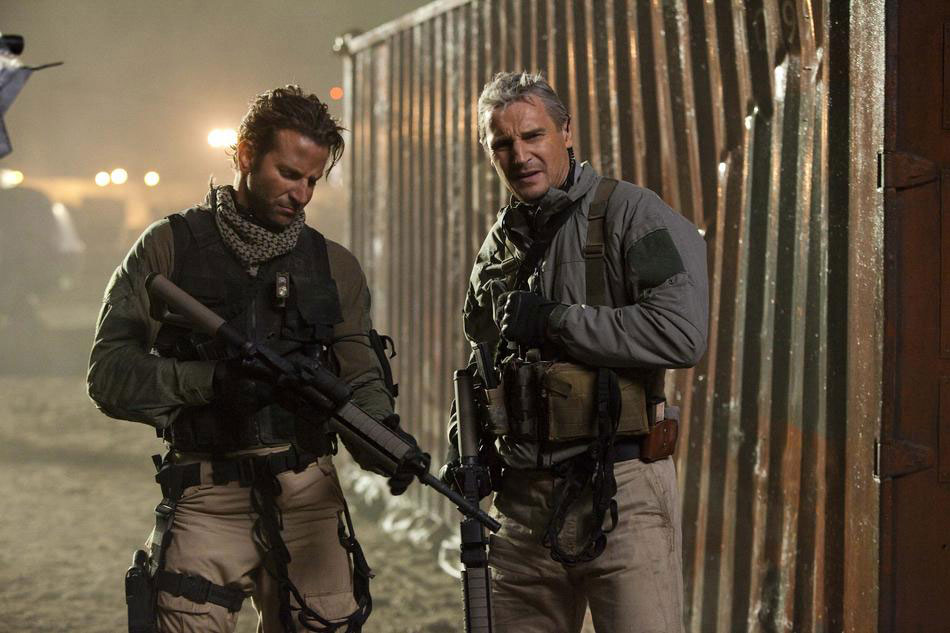
Bradley Cooper in trouble as "Face."
I think my love for these films is something universally understood.  The witty one-liners and the impossible escapades are great fun to immerse oneself in for a few hours.  And The A-Team is made for that.

The A-Team running from danger.
Based on the popular early 1980s television series, The A-Team is about a reckless elite army force of four soldiers, who, right as they are about to leave Iraq, get framed for a crime they didn't commit, stripped of their rank and imprisoned.  The film starts with the back story of how the team met, before leading into the day they are betrayed.  Colonel John "Hannibal" Smith, played by Liam Neeson, is the wise-cracking, cigar-smoking, somewhat fatherly and tactically brilliant leader of the group.  He is intensely loyal, with a strict sense of honor and a deep concern for his team.  Lieutenant Templeton "Faceman" Peck, played by Bradley Cooper and Bradley Cooper's fantastic abs, is the smooth-talking player of the group.  He can con anyone into anything, including most women into his bed, although he looks up to Hannibal and does his best to emulate him.  Bosco Albert "B.A" Baracus, played by Quinton Jackson, is the weapons and technical man on the crew.  He can drive anything, intimidate anyone, and is most notable for his Mohawk and "Pity the Fool" tattoos.  He's a softy at heart, however, and for some of the film tries to pursue a non-violent lifestyle.  He has to be frequently drugged whenever they board planes because of his fear of flying.  Which leads to the final member, H.M. "Howling Mad" Murdock, played by Sharlto Copley.  He is the clinically insane, unpredictable pilot of the group who always comes in with a "deus-ex-machina" device to save the day.  He's sweet, brilliant, and totally nuts.

Colonel "Hannibal" puts a plan together.
Predictably, within six months they all break out of jail and begin a mission to regain their lives by finding the U.S. Treasury plates they were accused of stealing.  They chase CIA operative Lynch, played by Patrick Wilson, and Black Forest thug Brock Pike, played by Brian Bloom, all the while staying one step ahead of DCIS Captain Charissa Sosa, played by Jessica Biel, who also happens to be Face's former flame.  Hijinks ensue, but the A-Team manages to save the day while still pulling off some ridiculous theatrics.  But in the end they are still placed under arrest, though they have cleared their name, because they illegally broke out of prison.  Before being led into the police car, Captain Sosa kisses Face, secretly transferring the handcuff key to him.  The group breaks out of the car where they go off to, presumably, fight another day.

"Face" and "Hannibal" get ready to fight.
It's so much fun.  The explosions are big, the wise-cracks just goofy, and have I mentioned Bradley Coopers abs?  They bear mentioning.  Abs.  I'm sorry what was I saying?

Bradley Cooper as "Face," tanning.
If all you want to do is turn your brain off, watch things explode, and enjoy a few hours of sillyness, this is your movie.  It is a little campy, with Neelson constantly puffing on a cigar and saying "I love it when a plan comes together,"  or when girls fall all over Cooper (I mean, abs).  But though I haven't seen it, I think this puts the film on the same level of the original show.  The corniness factor just makes it better for me.  You're supposed to want to groan good-naturedly at the film.

Original cast of 1983's The A-Team 
The one weak point for me was former UFC Heavyweight Quinton "Rampage" Jackson's performance as "B.A."  Maybe it's because Mr. T was such a presence in the original, but Jackson seems to have graduated from Paul Walker's "bro" school of acting.  He says, "Ohhhh, yeahhh," "I'm gonna kill you, fool!" and then tries for the sensitivity of a teddy bear.  Some of his scenes actually made me wince.

Quinton Jackson as "B.A" Baracus
Surprising highlight?  Sharlton Copley.  He's a South African actor, perhaps best known for having played the character of Wikus van de Merwe in the film District 9.  In this film, he changes accents, terrorizes B.A., has a tender moment with Face, and gets electric shocked in an insane asylum.  When he's on screen, he manages to steal the scene from both established actors Cooper and Neelson every time.  He's the character the audience is cheering for, and he makes this film the fun time it is.

Sharlton Copley as Captain Murdock
In conclusion, buy some beers, make some nachos, and sit down and watch The A-Team.  It's silly and pointless, and you may want to mute Jackson at some point, but it is definitely tons of fun.

PS-If you know any other good heist movies, please post below!
Enhanced by Zemanta